Thursday, July 24, 2014

The best vacation day...ever.

Yesterday, July 23rd, was the sixth day of my vacation, and so far one of my favorite days.  No, I didn’t go to the beach or anything like that.  I attended the NYC Salesforce.com User Group and helped facilitate User Group Therapy sessions. You may be reading this and looking at the title again, saying to yourself, “Didn’t she just say vacation day?”  Yes, you read correctly. 

A few weeks ago, I received an email from Kendra Webb-Scott, the NYC Salesforce.com User Group Leader, stating that she was going to be trying something new at the NYC User Group called User Group Therapy.  The description of this read, “You asked, and we listened! Our focus for the next meeting is all about YOU! One of the biggest benefits of the User Group community is getting tips and best practices from your peers to make the most out of your CRM. That's why we're introducing User Group Therapy - an open forum session to allow all attendees to ask questions, seek advice, share experiences and generally help each other out.”  When I read this, I immediately knew I wanted to attend this and offer up to help out.  I can’t think of a better way to give back to the community that has helped me so much than to facilitate a session like this.

Kendra had this broken out into three different 45-minute sessions, which were held downstairs from the main area where the partners were presenting.  There really weren’t specific topics, but each session had different facilitators.  The session I was facilitating with Jean Winget was first at 9 AM.  That first session had around eight attendees.  After brief introductions, we jumped right in and the questions and comments just started flowing naturally.  The questions included making sure the right people were informed about Opportunities, building mobile apps, data integrity, tools for data cleansing, and some general adoption questions.  My co-facilitator, Jean, is a database/data expert and offered up some great advice on what to do if you have dirty data coming in from an integration, and who you may want to reach out to at your company to help you fix it.  We ended the session by talking about some great administrator tools that come out-of-the-box, such as workflow, validation rules, visual workflow (flow), and of course, my favorite, publisher actions!

After the first User Group Therapy session ended, it seemed that word spread like wildfire about what was going on downstairs.  As I was gathering my things to head back upstairs, I realized how big the group had gotten in the room; it more than doubled in size for the next two facilitators, Ohad Idan and Carlos Frias.  I decided to stay because I thought there might be even more interesting discussion, because Ohad and Carlos both act as both admins and developers at their respective companies.  I have always enjoyed hearing their perspective on things, so I knew this was going to be a great session. 

The second session started similarly with brief introductions, then everyone just jumped right into it.  The first question was around Documents vs. Content.  Various people in the room, including myself, were able to answer questions on Libraries, some best practices on Libraries and some benefits of Content.  Then, someone in the room made a comment about the session in general, “I can’t say the word workflow at my company, because I’m the only one who understands what that word means.  I love that I can come here and talk to others who know what that means and can talk about challenges, ask questions, and see what others are doing.”  This started to lead the discussion around the path of community, not just community, but The Salesforce community and how great it is.  Carlos pulled up the New York User Group page on the Success Community and showed everyone how to access it.   People in the room started to share their stories of how much the community has helped them over the years.  Carlos and Ohad started to go through the different tabs on the community.  When they got to the Ideas tab, more discussion started to happen on why you should vote on ideas.  Ohad pointed out that they now put in the release notes all of the ideas that were delivered in that release.  I talked about how one of my ideas was delivered in this release, and how many Ideas points Salesforce Product Managers released this past release.  I also talked about the power of the community, and how if outside of these meetings if anyone needs advice just post on the New York User Group Page.  Once they got to the Answers tab, some of the attendees started to recount Steve Mo answering their question.  There was a lot of community love in the room. 

One of the other major topics discussed was Chatter, on successful rollout and adoptions. There was one name that must have come up about five times during this discussion, and that name is Becky Webster.  There were several of us talking about some of her great blog posts as well as her Dreamforce presentations from last year. We plan to post them on the New York User Group page so everyone can watch because they are so helpful. 

After the community discussion, the second session wrapped up with questions around communication and training to users and some best practices.  There were so many great suggestions in the room for the newbie admin.  In my opinion, this is why these sessions were so successful. You had people from all types of companies, in various roles, helping each other be successful. 

Allister McKenzie and Vikram Kamra, who both have a wealth of Salesforce knowledge and experience, facilitated the third session.  It was actually Vikram’s first user group in NYC, but even though he didn’t know anyone, he was completely willing to help as many people as possible and share more than a decade worth of Salesforce knowledge.  I figured I had stayed for the first two sessions, why not stay for all three? I’m so glad I did.  The third session went through even more detail on Chatter, including some of the benefits and how to convince your manager to let you roll it out.  There were so many great suggestions around this.  We also talked about the different types of Sandboxes, what a Sandbox is, and how you should use it.  I talked about how our developers use the different types of sandboxes for our development process.  I also encouraged everyone in the room, after they make sure they are on the success community, to go to developer.salesforce.com and sign up for a developer org. It’s free and you can play with all sorts of stuff. 

In the morning, I had set a goal for myself that I wanted to try and help five admins at the user group.  Together, we helped around 40 admins of all levels.  We received extremely positive feedback about these sessions, and Kendra has now made this a staple for the NYC User Group!  I am so happy to have been a part of this.

I will never forget when I first attended the NYC User Group and how happy I was to get help with my formulas.  If it weren’t for those people, I may not have the career I have today.  I’m hoping that at least one person has the same feeling and maybe at the next meeting they will help facilitate a session and pay it forward.  After reading this, I’m hoping now you will see why this was my favorite day of my vacation so far.  To me, this isn’t work, this is fun. 

As always, thank you for reading.

Cheryl

P.S. – if you haven’t attended your local user group, definitely do so, you can see a list of all user groups here.


Monday, July 7, 2014

Do Experienced Salesforce.com Admins Need A Certification?


Making the decision to get certified

As some of you know I have been a Salesforce Admin/BA for nearly 10 years, but I was never certified. It's not that I didn’t want to, it's just that I never made time for it. A few community friends of mine, as well as post from Button Click Admin, convinced me I should do it for a whole myriad of reasons. I started on this venture because I honestly got sick of people saying, “You’re so good I can’t believe you’re not certified, just do it you’ll pass.“

When I made my decision that I was going to get certified, I set a goal to be certified by July 31, 2014. I highly recommend putting a goal with an actual date around it otherwise you'll never take the plunge. You'll just keep saying next month or next year, which is basically what I did. I honestly made the decision because I was sick of people nagging me.


Studying and Practicing for the Certification

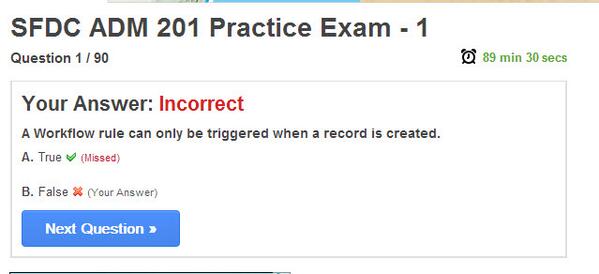
Once my mind was made up that I was going to do this, the first thing I did was google “Salesforce Practice Certification Test.” Oh boy where do I start?  There is some bad information out there. I remember taking one practice test and the first question on the test was clearly wrong. It only got worse as the test went on.


Here is an example of that:


I gave up on finding a good practice site and joined the “NYC Cert Club” which was members of the NYC User Group working together to get certified. Unfortunately my work schedule sometimes got so crazy I wasn’t able to make these sessions. Even though the sessions were recorded it wasn’t the same and I enjoyed the discussion and interaction I had with others. It's a great tool if you can make time for it, unfortunately I ended up having a mandatory meeting at the same time as this each week so it didn’t work out for me. I do highly encourage those who can carve out the time during their day to attend these. There are also certification groups on the community you can join here (please keep in mind you will need to meet their qualifications mentioned on their page).


I started to take a different strategy. I signed up for a new developer org solely for the purpose of practicing for the admin exam. When I first started on this venture, I was using a configuration only sandbox tied to my org.  Shortly after starting to study some out of the box features, I realized this was not the best approach since my org is so highly customized. Once I setup a free developer org, I found that it was even more beneficial for me, because I was able to see what Salesforce comes with out of the box.


I wasn't prepared for what was going to happen next...

An interesting thing started to happen that I was completely unprepared for. It was an unexpected surprise. I was learning not only for the certification, but for the benefit of my company and well, my career. After I spent about 4 hours on a Sunday afternoon reading the help section and playing around in my developer org, I sent an email to my team highlighting some best practices and even about some features we could be using. I started to see the benefit of the certification right away. It wasn’t that I just needed this cool little icon on my Twitter picture, it's that I was learning about features that I wouldn’t normally look at. Features I didn’t necessarily have requirements for, but I started to figure out ways our business users could use them. 

As I mentioned above when I first started this venture it was more about getting people off my back about getting certified rather than all of the benefit that could possibly come with getting certified. I think this was because I never really saw what the big deal was about being certified. My studying became more about how I could help better our implementation rather than a status thing or proving my knowledge to someone, which is what I prefer anyway and part of what drove me to keep doing this every Sunday. I was building my own knowledge as well as building our backlog.


Finally a Great practice resource

It was about a month ago when I came across a site called Certified on Demand. I was blown away. They offer free content as well as paid content. They have their site broken out into sections of the test. I decided to pay for a membership of $40.00. The first thing I did after paying for a membership is start taking the quizzes for each section without reading through the sections to see how well I did and what I needed to work on. Turns out on most of the quizzes I was scoring 90-100%. There were a few in areas where I hadn’t used or studied yet that I needed to work on. 

When I was taking the quizzes and I got something wrong I would write down the topic(s) on a piece of paper near my desk and keep a running list. Every Sunday, I would dedicate at least one hour to knocking a few of these items off of my list. What I would do is open up my dev org, and the help, section and learn about the topic/feature and start to play with it in my dev org. I personally find that I learn better by actually setting up a feature rather than just reading or memorizing something from the help section.


Jumping in with both feet

I looked at my calendar and June was halfway over. I decided to register for my exam, I figured if I had an exact date then I would push myself harder to spend more time studying. After I knocked all of my topics of my list and went through each one in my dev org it was the weekend before my certification. I decided to take the full practice test on Certified on Demand. You know what, all of the hard work paid off, first time around I got all but two correct! I looked at the two questions I got wrong and studied up and took it again Monday evening and got all but one correct. I started to google for more practice tests to cram the night before. I found some answers to practice questions on Shell Black’s website and got all of the questions correct! I finally felt ready. I was going to do this. I was going to pass my certification with flying colors on my first try.


Answering the original question

I am happy to say that as of July 1, 2014 I’m officially a certified salesforce.com admin. I don’t know if it makes me any better at my job, but I definitely learned a lot through this experience. So, do experienced or veteran admins need a certification? Absolutely. You may know everything about your org/implementation but there maybe features that you haven't touched that could be helpful to your organization. It's not just about your org it's about the platform as a whole. When you become certified you become more than just an expert at your company, but an expert on the overall platform. I used to never see the big deal, now I do. I know there are probably about a dozen people reading this rolling their eyes, yelling, "We told you so!" So to those dozen people, thank you for nagging me.

I would like to end this post by encouraging all “veteran admins” who haven’t been certified yet to do so. I guarantee that you will increase your knowledge about Salesforce beyond your org. Go for it. I did and don’t regret it one single bit.

As always, thanks for reading.
Cheryl

PS - If you think Salesforce should come out with a good practice test with questions and answers vote for my idea here.


Tuesday, June 24, 2014

How PEMDAS Can Help Salesforce Admins

I was recently contacted by a friend from the New York City User Group.  She was having trouble getting a validation rule to work correctly, she wasn't getting a syntax error, but the rule wasn’t firing at the correct time.  She asked if I had a few minutes to help her through this so she could get this new validation in production for their users.  I got on the phone with my friend and she emailed me their formula, which looked something like this:

 AND( Approval__c = false, 
Test_Price_1__c > Test_Price_2__c +Test_Price_3__c *.3)

 After speaking with my friend it turned out what she was trying to do was have a validation that a record couldn't be saved if it wasn’t submitted for approval and the first price field was greater than 30% of the sum of the second and third price fields. She couldn’t figure out what was wrong, she was able to save the validation rule so it wasn’t a syntax error. 

 What I ended up doing is quickly re-creating the fields in a developer org I have setup so I could play with the rule. She told me that when she was testing she was using 500 in the first price field and 400 and 500 in the 2nd and 3rd price fields respectively.  In her head she was thinking the result should be 270 (30% of 900), so she should not have been able to save.  

 After reviewing the calculation I realized what salesforce was actually calculating was 30% of 500 + 400 which equals 550 so that’s why was able to save her test record.  

 After she told me all of this I blurted out one word to her “PEMDAS”!  I heard a “huh?” on the other line of the phone. I started to explain to her the Acronym for the order of operations of Math and what her validation rule was actually calculating.

  I went through that Parentheses will be calculated first, Exponents second, then multiplication and division, then finally adding and subtracting.  Even though we were just on the phone I felt like I heard the light bulb go off in her head.  She said she understood what I meant and realized the problem wasn’t in her syntax but in her math.  She applied PEMDAS and re-wrote the validation like this:

 AND( Approval__c = false, 
Test_Price_1__c > (Test_Price_2__c +Test_Price_3__c) *.3)

 I was really happy that I was able to help my friend with her validation rule and pass on a great lesson from one of my favorite teachers of all time. 

After helping my friend I posted a facebook status sharing my re-found love of the PEMDAS Acronym.  “Mrs. Baker would be proud (my 7th grade math teacher). I still use PEMDAS to this day when writing Salesforce formulas. And you should too!”  

 It was through this post that I had a bunch of friends I went to Junior High with comment and share they all still use PEMDAS in their everyday lives too!  I also had some friends from the Salesforce world ask about PEMDAS which is what inspired this blog post.  If you would like to read more about PEMDAS or math in general check out this article from the Math is Fun website.  

 I would like to dedicate this post to my 7th grade math teacher, Mrs. Baker.  PEMDAS is just one of the many lessons that Mrs. Baker taught me. Mrs. Baker was all about making sure she fostered the love of math in both girls and boys.  She even had an afterschool program she ran called “Girls Count” which was open to girls of all grades in our Junior High.  Looking back I thought this was just a fun thing to do afters school that would help me in math and make friends. I didn’t realize that some of the lessons she taught us about believing in ourselves, going after our dreams and showing us that we could be just as good at math and science as boys would still be useful over 20 years later.  

 I hope this post helps some of you out there in Salesforce land and that you’ll think of PEMDAS the next time you write a formula or validation rule in Salesforce.

 As always thank you for reading.

 Cheryl

Wednesday, May 28, 2014

Let’s Have An Adminathon!

For the past few months I’ve had the opportunity to mentor 6 great women within the Salesforce community.  Most are what I consider a Next Generation “NextGen” Salesforce Admin.  These are your sales reps, secretaries, marketing professionals, customer service reps, power users, etc. that are passionate about the Salesforce platform but haven’t held a Salesforce Admin position yet.  These NextGen Admins want nothing more than to be a Salesforce Admin, some even hold certifications but lack work experience or maybe have some work experience but lack the certification.

As I’ve been mentoring these wonderful people and working with them to take the next step in their career, I started to see some common challenges.  They may have knowledge about the platform but aren’t exactly sure how to apply it.  Meaning how do they solve a business problem with their knowledge.  How can we take what they’ve learned studying for their certification and show them how to apply it to everyday business problems.  Admins rarely get requests of “Please create 3 roles where their records share with these 5 roles.”  Admins get a request like “Setup these 10 users that need to do x,y,z and have access to records from these people at this point in time and by the way these other 12 users need to be able to do that too but they can’t right now for some reason.”  

I’ve always said that Salesforce isn’t hard to learn its the analytical skills and business process that’s hard to learn.  So, how can we teach that to these NextGen Admins?  How can we as a community show what we’ve learned over the past x amount of years about problem solving and pass it along here.  Yes, there are some great blogs and things that talk about solving a specific business problem, but how do we give these people real life experience?  Showing the process of solving a problem and designing a solution using Salesforce.  How we troubleshoot, what to take into consideration, the types of questions to ask, how to see what’s already implemented and looking at existing data.  

A few weeks ago I was racking my brain about this.  I even went so far as to see if I could get additional interns on my team so I could bring some of these people on for a Summer so they could see what its really like and how we solve problems, communicate with users, manage expectations and requirements and all the things Salesforce Admins do.  Unfortunately we don’t have the budget for that this year, but it did make it to the ear of my VP, so maybe next year.  When I’m racking my brain about something and I just can’t figure it out, I tend to go for a walk to clear my head.  

I was standing on the corner of Wall St. and Broadway waiting for the light to change so I could cross the street, when I saw a guy wearing a Hackathon T-shirt.  It said something about a hackathon for social good and teaching others.  I remember thinking that’s cool a hackathon to help non-profits or at least that’s what it seemed like from his T-shirt.  As I was continuing my walk back to my office it hit me.  I sat down on the nearest bench and wrote this word “Adminathon” on the back of my receipt from lunch.  

When I arrived home that evening I pulled that receipt out of my pocket and started to think about the vision for an Adminathon and how I would like to see this concept setup and run.

Ideally I think it should be like a Hackathon, kind of, but no prize money.  It should be about teaching, learning and helping others.  What if we took problems from 3 non-profits (just making up a number here) where they didn’t have the money to solve.  Form 3 teams (1 team for each problem) of experienced Admins along with some NextGen Admins and solve the problem.  Walk them through exactly what we would do to troubleshoot, design and implement a solution.  Teach people while helping a non-profit.  

I originally thought Dreamforce might be a good place for this, but I think it maybe hard to accomplish. I started to think about the Salesforce1 Developer Week that recently took place. What if there was a similar Adminathon Week. What if in each major city there was something like this throughout a one or two week period each year.  Teaching Admins how to build completely declaratively solving real world problems for a real company using only Salesforce.  Also, if we do this locally it will help connect aspiring Admins to more experienced Admins for mentoring and networking for the future that are local to them.  This opportunity may lead them to a job for a company that’s hiring or a connection that may lead to a job.  The possibilities are endless.  

The reason why I think something like this would be so helpful is when I’m interviewing someone I’m not only testing their Salesforce knowledge but their problem solving and analytical skills.  I’m not necessarily always looking for the right answer in a question I ask, but interested to see how they got there.  That tells me a lot about their problem solving and analytical skills.  The key to being a great admin is to have all three of these things and I think with a combination of mentoring and something like this we can help people develop these skills.  

Now, I know what some of you are thinking how do we make this work logistically, how do we pick the Non-profits, how much time is involved and probably a whole list of questions I haven’t thought of.  These are all questions that need to be answered that I do not have the answer to.  

This is just my idea, maybe you have a better one to help the NextGen Admins.  I’m completely open to feedback and suggestions on any of my ideas.  Do you think it could work?  How would you implement it?

As always, thanks for reading, I do appreciate it.  

Cheryl

Tuesday, April 22, 2014

How I Got My Yes and Fulfilled My Dream of Becoming a Salesforce Administrator!

Since I posted my blog post last month on “All it takes is one yes”, the most common question I’ve gotten is how I went about getting my yes and how I was able to really make the jump from secretary to full-time Salesforce Administrator.  In honor of Administrative Professionals Day I thought today would be a great day to share this story.


When I had made the decision that I was ready to move-on from my company the first thing I did was get a resume ready.  I spent most of a weekend working on it.  I spent a Saturday afternoon in the Library reading books on Resume and Cover Letter writing.  I took out two books from the library that I thought would be useful guides for me.  I spent about 2-3 hours writing up my Resume and Cover Letter.  Once I had these written up I posted them on Monster and Careerbuilder.  I was sure I had a good resume and cover letter and that someone would contact me.  About two weeks had gone by and no real bites.  I had also applied to a few jobs on both sites with very little to no response back.  It was very frustrating.


I decided to reach out to a few friends from the NYC Salesforce User Group and send them my resume to see what they thought.  One of my friends got back to me and told me that I wasn’t highlighting my Salesforce Experience enough.  The way my resume was set up was that I had an objective then talked about my work experience under each job I had.  Listed in two bullet points under my secretarial role that I was doing Salesforce Administration and explaining what I had done.  


My friend sent me a copy of his resume and the first thing I noticed at the top was under the objective there was a skills section listing out in three columns his experience.  Each column was for a different overall skill set and then listing out the specifics.  Underneath that there was a list of different project accomplishments relating to both Salesforce and a few other systems he had worked on.  Then underneath that was his overall job experience where he listed his title, company worked for and duration of the position.  All of the meat and potatoes was as at the top of the resume.  I really liked this format and I knew this format could call out my specific Salesforce skill sets without hiding them underneath a secretary title.  I spent another weekend updating my resume to look like my friend’s resume.  It was definitely time well spent.  


That weekend I updated my resume on both monster and careerbuilder and applied to some open positions.  My friend’s suggestions worked!  That week I heard back from two of the companies I applied with and got a few calls from recruiters about open positions.  I had two interviews setup!  Hooray!


I would love to tell you that one of those two interviews lead to a job, but they didn’t.  I completely bombed my first interview.  I was no nervous.  The person interviewing me was asking me extremely technical questions that I didn’t even understand.  When I didn’t understand what he was talking about I would like down and say “no I don’t know how to do that, or no I’ve never seen that or dealt with that.”  The person interviewing me told me to get a few more years of experience under my belt and then reach out to him.  I felt like a complete failure.  I started to second-guess myself and wonder if I was ready to move into a full-time Salesforce Admin role.  I decided that I would go for the next interview a few days later and see how that went.


The second company I interviewed with went a lot better.  The role was for a salesforce administrator but instead of reporting into technology the role was reporting into sales operations.  I understood all of the questions being asked and was able to respond to all of them.  The person interviewing me told me that she really liked me and was going to set up a second interview for me with her boss and two of her colleagues.   The second interview I had went great as well.  I was able to answer questions and even call on my own Salesforce experience when they were talking about some of the challenges they were having.  After following up a few times after my interviews the hiring manager told me they put the position on hold.  She did tell me that if they hadn’t put the position on hold that I would have been their first choice.  That made me feel really good and helped me to keep going.


I went through another round of applying for jobs on every job site I could possibly find.  I also started applying for all Salesforce Admin jobs.  Even if they said they wanted five years of experience I applied anyway.  I decided it was better to get my resume out there even if I didn’t fit their qualifications exactly.  That was one of the best decisions I ever made.  I got more interviews this way.  Let’s face it, in 2005, Salesforce had only been around for six years so not many people had five years of Salesforce experience.  


It was coming towards the end of the Summer and I was still interviewing and applying for jobs.  I had interviewed with about 8 different companies and no offer yet.  I learned something new during each interview, something that would make me better for my next.  I learned how to answer questions better so I became more confident.  I learned that it was ok to say “no I haven’t dealt with that situation exactly, but I know I can learn.”  I was searching one evening on Monster when I saw a job for a Field Operations Manager/Salesforce Administrator for a start-up company in the NYC suburbs.  They were looking for someone with 1-2 years of work experience and 1-2 years of Salesforce experience.  I applied for the job.


A few days after I applied for the position at the start-up I got a call from their operations manager. He wanted to bring me in the following week for an interview.  That weekend, I was at a family barbeque telling my family of my upcoming interview and my Mom told me she had a really good feeling about this one.  I did too.  A friend of the family gave me some advice, she told me to walk in there like I owned the place, like the job was already mine.  I decided to do just that.  I was going to be confident, poised and knowledgeable on this interview.  I decided that I was going to ask them what their biggest Salesforce challenge was and see if I could solve it for them.  


During the interview I was able to answer all of their questions and at the conclusion of the interview the operations manager asked me if I had any questions.  I decided to go for it.  I asked “What’s your biggest challenge with Salesforce?”  


He looked at me and I think was a bit taken back by my question.  He turned the computer screen around on his desk and showed me the Administrator profile.  They had 50 users and 28 were administrators because they couldn’t figure out why when they moved a user into a service role and profile they could no longer see accounts owned by sales managers.  He then showed me his dashboard which had all of these error messages on it where reports weren’t rendering.  He also told me that because there were so many system admins that they had duplicate fields, duplicate (similar) picklist values and a big giant mess.  Essentially they had Salesforce for just over a year but the person who started the project of implementing it had moved on before they could finish so they had a lot of stuff that wasn’t working, people had too much access and they weren’t really sure what it could do.  


I spoke to him briefly about his first issue with visibility, I explained org wide defaults for objects, sharing, roles and profiles.  He seemed to get it.  Unfortunately he had another meeting but he told me he did want to continue the conversation and bring me in for a second interview with his boss, the COO and a few others the following week.


Instead of sending a generic thank you for interviewing me email, I decided to send a plan over on how he could fix his Salesforce org and some things he could do right away to move people out of the admin role and eliminate so much risk.  I also offered to take a day off from my current job and work with them so they could “try me out.”


The next day the Operations Manager called me.  He couldn’t believe that I sent him everything I sent him in just a few hours after our meeting.  He took me up on bringing me in the following week.  I took a personal day from my current secretarial job and arrived at what I knew would be my next employer ready to get started on fixing their Salesforce org.


I spent a good part of the morning fixing their role hierarchy, creating sharing rules and moving users out of the administrator profile.  By noon I had moved over 20 people out of the Administrator profile and you know what they didn’t even notice because they were able to see the correct Accounts, Contacts and Opportunities.   After lunch I spent the remainder of the day fixing reports and dashboards so they would run correctly.  I also added some more charts to the dashboard for some key metrics I thought they’d want to see.  I also made a list of duplicate fields and ran reports on usage and sent them to the Operations Manager so he could let me know which fields could be merged.  I also told him about the data loader and that once he made that decision that I could easily load the data on the back-end to the surviving field so no data would be lost on purging fields.


At the end of the day the Operations Manager called me into his office.  In his office was the COO and the CFO of the company.  He was showing them everything I did in one day.  They couldn’t believe it.  The COO was so happy that her dashboards were running.  The CFO was so happy that she could see all of the correct opportunities and didn’t have to be in an admin profile anymore.  We spent the next 15 minutes going through my plan of how we could clean up the duplicate fields and picklist values.  At the end of the conversation the Operations Manager got up and picked up a piece of paper off of his printer and handed it to me.  It was an offer letter!  The CFO went back to her office and came back with a check.  Not only were they offering me a job, they were going to pay me for the day.  I of course signed the offer letter right then and there.  

Sometimes all it takes is a little thinking outside the box to get your Yes.  If you’re reading this blog and still waiting for your Yes.  I’m here to tell you that I believe in you.  I know you can do it.  

I was so excited when I started this job.  On my first day, they gave me business cards!  I don’t know why that was so special to me, but it was.  It was like you know you’ve made it when...you have your own business card.  My first few months were spent re-implementing their org and fixing their issues.  After that was complete I worked on some cool projects regarding routing and invoicing.  You can see more about that on Button Click Admin!  

As always thanks for reading and Happy Administrative Professionals Day!


Cheryl

Thursday, April 17, 2014

And Then My Worlds Collided…The Beautyforce Concept


For as long as I’ve been doing Salesforce Administration work I've always tried to figure out how can I make my two favorite things, Salesforce and Makeup work together. I was never sure what that meant, but I always thought it would be cool if I could introduce my makeup friends to Salesforce somehow and my Salesforce friends to the world of makeup.  I had pretty much resolved myself to the fact that my worlds would always have to remain separate and I would never find a way to incorporate makeup into Salesforce or Salesforce into makeup.

It was sometime in late January when my team and I started really looking at Salesforce1 and how our company could use it and what we would have to do to get our company and our org ready to use it.  We don’t have chatter on and I wanted to play with some things with publisher actions to see how things would work conceptually so I opened up a new developer edition org and started to build out a custom object and create some publisher actions.  I wanted to create something cool to test out the power of publisher actions and the power of Salesforce1.  At first I was starting to re-build my own org more declaratively but that would be so time consuming and challenging I wanted to start with something a bit simpler.  Maybe something that didn't have to do with my day job. I started to think of ideas that had to do with the Financial Services Industry but I wasn’t sure if I wanted to go that route.  I happened to be working from home and decided to take a break from ‘Salesforcing’ and go back to organizing my lip products by color and type.

As I was sitting on my bedroom floor sorting my lipsticks, lip glosses, lip pencils, lip primers and lip balms I was also entering information about these products into a google doc so I know what I have as far as product, what I thought of it and which skin tones/lip type it works best on.  It was so time consuming to do this.  I remember thinking “I wish they had an app for this”.  And BAM it hit me like a pile of bricks.  I could create something in Salesforce1 to track this information.  And there it was.  My longtime dream of combining Salesforce and Makeup was sitting right there in front of me and I didn’t even realize it.  I decided right then and there sitting on my bedroom floor surrounded by hundreds of lip products that I was going to try and build this app.  I wanted it to be more than just a place to track makeup products.  I had a flurry of ideas running through my head of how Salesforce1 could work for makeup artists, hair stylists, colorists, beauty bloggers/vloggers, salon owners and your average makeup/beauty consumer. 

I wanted to run my idea by a few people so I reached out to a few friends in the beauty/makeup community that I know and asked if they wanted to grab cocktails over the weekend to talk about an idea I had.  I had cocktails with three of my friends; a makeup artist, a salon owner and a beauty blogger.  I told them of my idea and I explained Salesforce1 to them and showed them potentially how it could work.  All three of them thought it would be an incredible idea especially my friend who does blogging.  She tracks everything in notes on her iPhone and it’s not very organized or user friendly. 

My friend who owned the Salon thought it could be awesome for different reasons.  Right now he has to have these large areas in his salon taken up with computers for scheduling and for looking up color cards and client history and they take up so much space.  His dream is remove the whole front desk and the ‘colorist console’ and replace it all with iPads/iPhones.  He asked me if I thought the app could do that.  My brain really started to wrap itself around this idea and I told him that I thought it could or at least I hope it will be able to!

My friend who is a makeup artist; we both are obsessed with Uber.  We take it all the time especially after a late night in the city and we always say why isn’t everything as simple as Uber.  Why can’t I push a button on my phone and everything be there in front of me less than 10 minutes?  We’ve spoken about this idea before the idea of having an app where someone is sitting at their desk at work and they decide they need their makeup or hair done.  They can open an app request a type of beauty service at a specified location and then someone picks up their request and does their hair, makeup or whatever service they requesting. 

My friend, the salon owner turned to me and asked “So what are you going to call this thing?”  That was a good question, I originally thought of makeupforce, but this was so much more than that.  It involves the whole beauty world.  A light bulb went off in my head.  I turned to my friends and said “Beautyforce”. 

I left my friends that night feeling more energized than ever about this idea.  The next day I jotted down everything I wanted in this app.  The list was huge; two full pages back and front in a notebook.  I then decided this needed to be broken up into separate sub-apps that fulfill a different use case, but all centered around the same thing, beauty/makeup products and services.

Unfortunately for the past month or so I have been working 60 hour weeks at my day job, plus the Financial Services User Group, plus my blog, plus mentoring so sadly this app got put on the back-burner.

I resurrected it last week and started building it again and have a shell of what it would look like from the first “sub-app” which would be the one potentially used by both the beauty blogger/vlogger and regular consumer. 


There is a lot of work still yet to be done on this app and a lot of it will need development to accomplish the overall vision I have.  I just don’t have enough hours in the day to accomplish this on my own.  For those of you who have helped me on the community so far you know that I’ve been working on this from the hours of 11 PM – 1 AM a few days per week as that is really the only free time I have.  If anyone would like to help me out with this let me know.  I’m completely open to partnering with someone from the community on this and sharing the overall vision of each app. 

Here are a few screen shots:


Anyway, I would love to know what all of you think of the overall idea and if anyone has built anything like this on Salesforce1. 

As always, I appreciate you taking the time to read and share your thoughts.

Thank you,

Cheryl 

Friday, April 4, 2014

My Dream at Dreamforce & How the Salesforce Community helped Make it a Reality


If you've read my blog about how I built my career on Salesforce then you already know that I’ve worked in the financial services industry for more than half of my Salesforce.com Admin/BA career.  Prior to this I spent time with a B2C startup and a large Healthcare company.   What this means is that approximately 85% of my career has been spent in a Highly Regulated Industry.


One of the Dreamforce ’13 highlights for me was the Financial Services Industry Day.  I found the sessions really useful, informative and geared towards people like me.  I remember thinking after each session “Yes, I go through that”, “Yes, I’ve dealt with that”, or “Yes these people understand me and don’t think I’m insane. Hooray!”


After the day ended there were two people that I sat next to for most of the day through various sessions and we decided to grab something to eat.  The nature of our conversation naturally turned to our Salesforce orgs.  We all had similar roles within our companies, however we were all in completely different Financial Services sub-sectors.  We had so many common challenges within our implementations or even with compliance or regulatory.  After I left my two new friends during the walk back to my hotel I smiled to myself and thought “I wish I could talk to people like this all the time.  I wish I could meet up with people from my industry a few times a year and talk shop.  These are my people, they get me.”


As I was riding in the elevator up to my hotel a light went on in my head.  There should be a Financial Services Industry User Group.  Then I started to wonder if I could start something like that?  Would Salesforce be supportive?  How would I do that?  Would anyone be interested in this?


The following day I was speaking with Roger Mitchell from Silverline about my idea for a Financial Services User Group to see what he thought.  He was the first person I really vocalized this to so I wasn’t sure what to expect.  He was extremely supportive and even offered to help me if I decided to move forward on this idea.


About two weeks after Dreamforce I was still thinking about the idea of a Financial Services User Group and was wondering how Salesforce would feel about this type of group.  I was attending a regular MVP Office Hours session in December when Josh and Jarrod mentioned if we ever had any MVP questions we could always tweet them.  Later that day I took advantage of their offer and asked them if there were any MVPs in the Financial Services Industry.  In a few short hours they had connected me with Denise Carbone who leads the Chicago User Group and Geraldine Gray whom I already knew from the Girly Geeks events at Dreamforce.


Within a few days I had conversations with both Denise and Geraldine about my idea for Financial Services Salesforce User Group.  They were both extremely supportive of the idea were willing to give me tips and general advice.  Denise offered to connect me with Matt Brown at Salesforce about my idea.  I had a very successful conversation with Matt a few days later! He thought it was a great idea and that there would be a lot of interest.  All I had to do was let him know I was ready to move forward and he would get me setup.


After hanging up with Matt, I typed a quick email to Roger asking him if he had time to talk later this week about the Financial Services User Group and that I was ready to move forward.  Roger got right back to me and told me to set something up and include one of his colleagues, Maggie Rupel.  We had a 20 minute conversation that went better than I could have ever imagined.  Not only were they willing to help promote an event, but Silverline was willing to sponsor and host the event.  I will never be able to communicate in words how much this meant to me.  My little Financial Services Salesforce loving heart swelled with joy after this phone call.    


After my call with Roger and Maggie, I reached back out to Matt and had him get me setup.
On my way down to the Saleforce1Tour in January I was making a list of all of the things I was going to have to do by February 27th to get this User Group rolling.  The list was mighty, long and overwhelming.


While chatting with a few people at the User Group booth I ran into Adam Ady, whom I knew from the Developer User Group in NYC.  He mentioned to me he recently transitioned to a new role within Financial Services and he was thinking of trying to get a bunch of other Financial Services Salesforce people together to talk.  I told him that “great minds must think alike” and that I needed some help.  I asked if he would be my co-leader and he said “Yes!”  We started to tell more people after the event about our newly formed User Group.  There wasn't a single person we told that wasn't supportive or willing to help in some way.


Shortly after the Salesforce1 tour ended I remember thinking Erica and Matt aren't joking when they talk about Salesforce having the best Community in the world.  In just a few days I had so many people willing to help me and guide me.  There were other User Group leaders offering their tips and suggestions, there were people sharing the link to the registration on their twitter or community pages.


We had our first meeting as planned on February 27th and it was a huge success.  A bigger success than I could have ever imagined when I was talking to Roger at Dreamforce.  For the first time ever people in the Financial Services Salesforce world were sharing their ideas, experiences and challenges with Salesforce.  And you know what, we were right.  We all do have the same challenges and we are going to solve them together and be successful together.  


Our Financial Services Salesforce User Group Community page now has over 400 members and we’re gearing up for our second in person meeting in early May as well as our first virtual meeting.  


Thank you to everyone who helped along the way.  We couldn't have done it without you.  This community really is like a second family. 

Thanks as always for reading and sharing,

Cheryl